


The White Gold of Awadh: The Definitive Archive of Chikankari in Cinema, Royalty, and Global High Fashion
- Feb 9
- 8 min read

From the courts of the Mughal Emperors to the red carpets of the Oscars. A complete chronicle of how Lucknowi Chikankari became the chosen couture of Princess Diana, Judi Dench, the Pataudi Royals, and the Ambani dynasty.
The Embroidery of Shadow
There are fabrics that shout, and then there are fabrics that whisper.
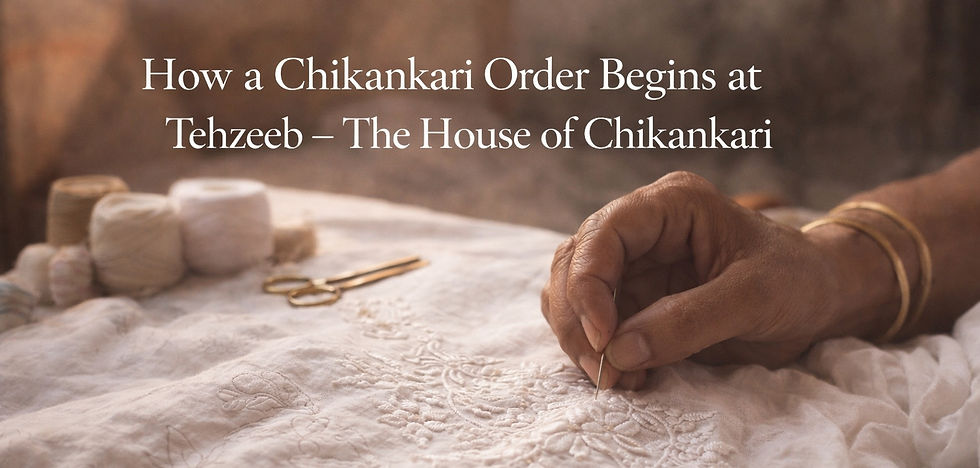
In a world of neon synthetics and digital prints, Lucknowi Chikankari is the quietest luxury of all. It is an art form born of patience. It is the "Embroidery of Shadow" a technique where the thread is often applied on the wrong side of the fabric to create a ghostly, ethereal outline on the front. It is a craft that relies not on the dazzle of sequins (though it welcomes them), but on the play of light against texture.
For over 400 years, this delicate white-on-white needlework was the exclusive domain of the Nawabs of Awadh. Today, it is the global uniform of the "Old Money" aesthetic.
But how did a regional craft from the lanes of Lucknow travel to the wardrobe of the Princess of Wales? How did it become the "lucky charm" for a Hollywood legend at the Oscars?
This is the untold story of the faces famous, royal, and iconic who transformed Chikankari from a traditional textile into a global symbol of power.
CHAPTER I: THE ROYAL WARRANT
When Blue Blood Wears White Thread
True luxury is never about the price tag; it is about provenance. For the royalty of India and the West, Chikankari has served as a sartorial diplomat a fabric that commands respect without demanding attention.
1. The House of Pataudi: The Custodians of Culture
If there is one family that holds the unspoken copyright on the "Chikankari Aesthetic," it is the Pataudis. For them, this is not fashion; it is heritage.
Mansoor Ali Khan Pataudi (The Tiger): The late Nawab established the "Gentleman’s Code" for the fabric. He was rarely seen in anything other than a pristine, starched white kurta. He proved that for a man of stature, simplicity is the ultimate sophistication. He did not wear embroidery to look rich; he wore it because he was rich in culture.
Sharmila Tagore: The Begum brought a unique fusion to the Pataudi wardrobe. She often mixed the Gara embroidery of her Parsi heritage with the Murri (knot) work of Lucknow. Her chiffon Chikankari sarees, worn with sleepless blouses in the 60s, defined an era of intellectual glamour.
Saif Ali Khan: The current Nawab has single-handedly kept the kurta-pyjama relevant for the modern Indian man. Whether he is at an airport or a book launch, Saif’s look a white Chikankari kurta, often paired with white trousers and brown leather oxfords is the gold standard for men’s ethnic wear. He treats the fabric as "daily luxury," stripping away the stiffness of formal wear.
Kareena Kapoor Khan: As the Begum of Pataudi, Kareena has elevated the craft to high fashion. Her choice of a Narjis (narcissus flower) motif Chikankari suit for her wedding registry, and her annual Eid appearances in ivory ensembles by designers like Narjis or Abu Jani Sandeep Khosla, serve as a masterclass in regal dressing.
2. The Princess of Wales: A Diplomatic Love Affair
The world stopped in 1997 when Princess Diana visited Pakistan.
While she had access to every couture house in Paris, for this trip, she turned to the East. She famously wore a powder-blue salwar kameez designed by Ritu Kumar (a pioneer in reviving Indian crafts). The outfit featured intricate embroidery that mirrored the delicacy of Chikankari.
The Impact: When the most photographed woman in the world wore the silhouette, she validated the "modest luxury" of the subcontinent. She showed the West that an embroidered tunic was just as elegant as a Chanel suit.
3. The Duchess of Cambridge: The Legacy Continues
In 2019, Kate Middleton followed in her mother-in-law’s footsteps during her Royal Tour of Pakistan. She wore a blue kurta with white embroidery that bore a striking resemblance to the classic Lucknowi tepchi stitch.
The "Kate Effect": Following her appearance, searches for "Blue Kurta with White Embroidery" spiked globally by 400%. It was a lesson in "Soft Power" using fabric to build bridges between nations.
CHAPTER II: THE HOLLYWOOD CONNECTION
From Lucknow to Los Angeles
It is a common misconception that Chikankari is a purely "ethnic" trend. In the highest circles of Hollywood, it is considered "Wearable Art," a collector's item on par with vintage jewelry. The bridge between these two worlds was built by the legendary design duo, Abu Jani Sandeep Khosla (AJSK).
1. Dame Judi Dench: The Oscar’s Best Kept Secret
The relationship between British acting royalty Dame Judi Dench and Lucknowi Chikankari is one of fashion’s most beautiful stories.
The 2001 Oscars: Nominated for Chocolat, Judi Dench walked the red carpet not in Versace or Armani, but in a black Chikankari creation by AJSK. The outfit featured the Pakeezah style of embroidery dense, heavy, and majestic.
The "Lucky Mascot": Dame Judi has famously called her Chikankari outfits her "lucky mascots." She has worn the embroidery to the BAFTAs, the Venice Film Festival, and numerous premieres. For her, the density of the Jaali (net) work offers a texture that Western lace simply cannot replicate.
2. Madonna: The Spiritual Phase
In the late 90s, during her Ray of Light era, Madonna turned to Indian aesthetics to represent her spiritual awakening. She was frequently photographed in white Chikankari tunics. For Madonna, the white-on-white embroidery symbolized purity and a "clean slate," perfectly aligning with her reinvention as a spiritual icon.
3. Beyoncé: The Global Stage
Fast forward to 2024, and Beyoncé the Queen of Pop stunned the world at the Ambani wedding celebrations. She wore a custom outfit by Indian designers that utilized the high-drama techniques of Indian embroidery. While her look was jewel-encrusted, the base technique relied on the same principles of hand-craftsmanship that define Chikankari: thousands of hours of human labor to create a single garment.
CHAPTER III: CINEMA AS THE ARCHIVIST
How Bollywood Preserved the Craft
Before Instagram, there was Cinema. Bollywood has been the single greatest archivist of Chikankari, documenting its evolution from the black-and-white era to Technicolor.
1. The Golden Age: Texture Over Color
In the era of Black and White cinema, costume designers faced a problem: pure white cloth looked flat and "blown out" under studio lights.
The Solution: Chikankari. The raised threadwork of the Bakhiya (shadow stitch) and Phanda (knots) created shadows on the fabric.
Meena Kumari in Pakeezah: This film is the "Bible" of Lucknowi aesthetics. Meena Kumari’s costumes featured the finest mukaish (metal wire) work blended with Chikankari. The sheer dupattas, weighing almost nothing, allowed the camera to capture her vulnerability. The fabric didn't just cover her; it revealed her soul.
Waheeda Rehman: In films like Chaudhvin Ka Chand, she wore the classic Lucknowi sharara. Her costumes established the trope that "The Muslim Social" genre required the specific elegance of Chikankari to be authentic.
2. The Matriarchs of Style
As cinema moved into color, a group of actresses adopted Chikankari as their off-screen signature, cementing it as the fabric of the intellectual elite.
Jaya Bachchan: She is the undisputed queen of the "White Abu Jani Sandeep Khosla Anarkali." For decades, she has worn heavy, floor-length Chikankari ensembles to every major industry event. Her consistency has branded the fabric as the uniform of the "First Family of Bollywood."
Dimple Kapadia: While Jaya represents tradition, Dimple represents the "Boho-Luxe" vibe. She wears oversized Chikankari kurtas with oxidized silver jewelry and wild, open hair. She taught Indian women that Chikankari could be messy, sexy, and artistic.
Rekha: The enigma. While known for her Kanjeevarams, Rekha’s casual wardrobe is strictly white Chikankari. She wears the Churia (bangle) sleeves tightly gathered sleeves that require immense skill to stitch proving her eye for technical detail.
CHAPTER IV: THE MILLENNIAL RENAISSANCE
The Democratization of Luxury
In the last decade, a new generation of stars has taken Chikankari out of the "Special Occasion" box and put it into the "Daily Wear" box.
1. The "Airport Look" Revolution
If you walk into a Chikankari store in Lucknow today and ask for the "Deepika Wala Kurta," they know exactly what you mean.
Deepika Padukone and Janhvi Kapoor normalized the "Kurta and Jeans" combo. By wearing sheer, white Chikankari kurtas with blue denim and tote bags at the airport, they stripped the fabric of its "weight."
The Impact: This single trend revived the livelihood of thousands of artisans in Lucknow. Suddenly, young college girls wanted Chikankari, not just their mothers.
2. The Wedding of the Decade: Athiya Shetty
Athiya Shetty’s 2023 wedding to KL Rahul was a watershed moment for bridal fashion.
The Look: She wore a custom pink Chikankari lehenga by Anamika Khanna.
The Details:
10,000 Man-Hours: It took artisans 416 days to create.
Material: Silk Organza and Zardozi work mixed with Chikankari.
The Twist: It wasn't traditional red. It was a dusty "Old Rose" pink.
Why it Matters: Athiya proved that a modern bride doesn't need to be weighed down by 20kg of velvet. She can be light, breathable, and ethereal. She made Chikankari the "Cool Girl" bridal choice.
3. The Ambani Wedding: Radhika Merchant
At the recent Ambani nuptials, Radhika Merchant showcased the versatility of the craft. She wore a tri-colored Chikankari ghagra by Abu Jani Sandeep Khosla.
The Innovation: Chikankari is traditionally white or pastel. By rendering it in bright pinks, oranges, and greens, the Ambanis and AJSK showed that the craft can be vibrant, festive, and maximalist.
CHAPTER V: THE GENTLEMEN’S CLUB
Shadow Work for the Leading Man
Chikankari is often misunderstood as a feminine craft (due to the floral motifs), but Bollywood’s leading men have reclaimed it as a symbol of rugged sophistication.
Shah Rukh Khan in Raees: To play the character of a bootlegger in Gujarat, SRK wore Pathani suits. But look closely they were textured. The subtle threadwork gave his character depth. Off-screen, SRK is famously known to wear white Chikankari pathanis for Eid greetings at Mannat, creating an image of the "Benevolent King."
Ranbir Kapoor: For the promotions of Brahmastra, Ranbir frequently wore short Chikankari kurtas with jeans and sneakers. This "Fusion" look bridged the gap between the traditional craft and the modern sneakerhead generation.
WHY THE WORLD ALWAYS RETURNS TO LUCKNOW
Why, in 2026, are we still obsessed with a 400-year-old embroidery technique?
Because we live in a digital world. Everything is fast, flat, and replicated. You can 3D print a dress. You can digitally print a pattern. But you cannot fake the human touch.
You cannot fake the 10,000 hours it took to make Athiya Shetty’s lehenga. You cannot fake the "Shadow Work" that makes a white kurta look like it is glowing from within. You cannot fake the history that Dame Judi Dench wears on her sleeve.
Chikankari is the antidote to Fast Fashion. It is slow. It is imperfect. It is expensive not just in money, but in time.
When you wear a piece of authentic Lucknowi Chikankari, you are not just wearing a garment. You are wearing a story. You are joining a lineage that stretches from the Mughal courts to the Pataudi Palace, from the sets of Pakeezah to the red carpet of the Oscars.
You are wearing the only fabric in the world that doesn't need to shout to be heard.
The Vocabulary of the Craft
To truly appreciate the celebrity looks mentioned above, one must understand the lexicon of Lucknow.
Tepchi: The running stitch, often seen on the "Airport Looks" of Janhvi Kapoor. Simple, linear, and durable.
Bakhiya (Shadow Work): The signature stitch. The thread is crisscrossed on the reverse side, creating a shadow on the front. This is the technique favored by the Royals for its subtlety.
Phanda: Millet-shaped knots. These create the texture often seen on the heavy coats worn by Judi Dench.
Jaali: The net. The artisan pulls the warp and weft threads apart to create microscopic holes without cutting the fabric. This is the hallmark of "High Couture" Chikankari.
Own a Piece of the Legacy
As we have seen with the heirlooms of the Pataudis and the red-carpet masterpieces of Hollywood, true luxury is rare. It cannot be mass-produced. It can only be curated at Tehzeeb - The House Of Chikankari, we do not manufacture clothing; we commission art. Because our artisans spend months on a single motif, our collections are strictly limited.
Each piece is unique, carrying its own thumbprint of the creator, just like the vintage pieces worn by royalty.Do not just watch history. Wear it.


Comments